Betting in Your Pajamas: Why Your Couch Is the Most Dangerous Place to Gamble
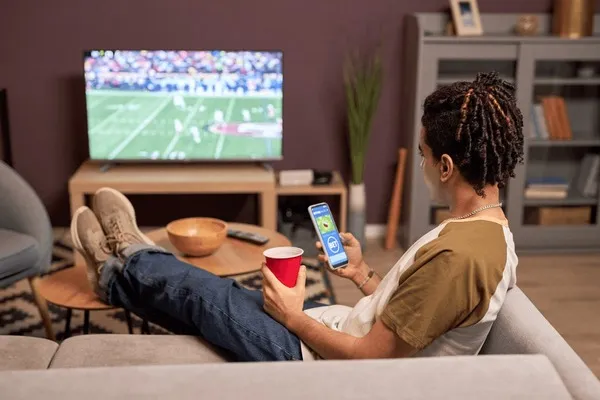
Photo: person using smartphone sports betting app at night on couch, via www.shutterstock.com
There's a version of gambling that comes with built-in guardrails. You drive to a casino, park the car, walk through the doors, find a seat, exchange cash for chips, and eventually — whether you're up or down — you go home. Every one of those steps is a small moment of friction, a tiny pause between impulse and action. Most people never think about those pauses. But they matter more than you'd expect.
Now compare that to mobile sports betting. You're on the couch watching the fourth quarter of a game you already have money on. Things aren't going your way. Your phone buzzes — a push notification from your sportsbook with a live in-game line. Three taps and you've placed another bet. Thirty seconds, start to finish. No friction. No pause. Just impulse and action, back to back.
That's the environment most American bettors operate in today. And it's worth understanding what it's actually doing to your decision-making.
The Friction You Didn't Know Was Protecting You
Behavioral economists have studied friction for decades. The basic finding is almost uncomfortably simple: when you make something harder to do, people do it less, and they think more carefully before doing it. Friction slows down automatic, impulsive behavior and gives the rational part of your brain a chance to catch up.
Physical casinos are full of accidental friction. Cash is the primary currency, which means you're regularly converting real dollars into chips — a psychological buffer that still exists but forces a moment of deliberate action. Drinks come slowly. ATMs charge fees. The walk back to the parking garage is long enough to cool off.
Mobile betting apps have spent years engineering all of that friction away. One-tap deposits. Saved payment methods. Instant bet confirmation. It's brilliant product design from a user-experience standpoint and absolutely devastating from a bankroll-management standpoint.
Session Length: The Metric Nobody Tracks
In a physical casino, sessions have natural endpoints. You get tired. You get hungry. The place closes. Social pressure from whoever you came with eventually pulls you out the door.
On your phone, none of those limits exist. It's 2 AM on a Tuesday, there's a Korean baseball game on, and your sportsbook is wide open. Session length on mobile platforms tends to run significantly longer than in-person gambling sessions — and longer sessions correlate strongly with worse decision-making, more impulsive bets, and higher net losses.
Part of this is simple fatigue. Cognitive resources deplete over time, and the disciplined thinking that protects your bankroll early in a session gets progressively harder to maintain as the hours go by. Part of it is something darker: loss-chasing.
The Chasing Trap
Loss-chasing — increasing bet size or frequency after a loss in an attempt to recover — is one of the most well-documented patterns in gambling behavior. It's also one of the most reliably destructive.
In a physical setting, chasing has logistical limits. You have to go back to the ATM. You have to rebuy chips. There's a moment — often an embarrassing one — where you have to make a deliberate choice to continue. Many people turn around at that moment.
On mobile, the path from loss to next bet is essentially frictionless. Your bankroll is right there. The next game is right there. The notification just told you there's a live line with value. Chasing behavior that might have stopped at the ATM instead spirals through six more bets before you even fully register what's happening.
If you've ever looked at your betting history after a bad night on your phone and genuinely couldn't account for some of the decisions you made, you've experienced this firsthand.
How Notifications Work Against You
Let's talk about push notifications, because this one is specific to mobile and it's more manipulative than most bettors realize.
Sportsbooks use notifications strategically. They're timed around live games, during halftime windows, after big scoring plays — moments when emotional arousal is high and rational decision-making is at its lowest. "New live line available" hits different when you're already frustrated watching your bet go sideways.
The apps also use personalization engines that track your betting patterns and surface the types of bets you've engaged with before, including the ones that have cost you money. It's not malicious in a dramatic sense — it's just product optimization. But it's optimization aimed at engagement, not your bottom line.
Turning off betting app notifications is one of the highest-leverage, lowest-effort moves you can make for your bankroll. It sounds almost too simple. It works.
Practical Guardrails for the Mobile Era
None of this means mobile betting is something to avoid entirely — convenience is real, and platforms like 98Abet are built to make the experience smooth and enjoyable. But smart bettors build their own friction back into the process.
A few things that actually work:
Set a session timer. Decide before you open the app how long you're going to be in it. When the timer goes off, you close the app. No extensions, no exceptions.
Pre-commit your bets. Do your research, decide what you're betting, write it down, then place those bets. Anything you consider after that initial list is reactive, emotional, and statistically likely to be worse than your planned wagers.
Separate your betting bankroll from your main account. When your sportsbook balance is funded by a distinct deposit you made deliberately, you're less likely to reload impulsively in the middle of a session. The act of depositing more money should feel like a decision, not an automatic reflex.
Impose a post-loss waiting period. If you've just lost a bet and you feel the pull to place another one immediately, wait 15 minutes. Set a timer. Most loss-chasing impulses don't survive 15 minutes of deliberate delay.
The Phone Doesn't Care If You Win
This is worth saying plainly: your sportsbook app is not designed to help you win. It's designed to keep you engaged, make depositing easy, and surface betting opportunities constantly. That's not a conspiracy — it's just the business model.
The bettors who navigate mobile platforms successfully are the ones who understand this dynamic and build personal systems that counteract it. They use the convenience for research and line shopping. They resist the real-time emotional triggers. They treat their phone like a tool rather than an entertainment device that happens to also take their money.
Bet bold, sure. But play smart — and playing smart in 2024 means knowing exactly how your phone is designed to work against you.